The Newark parks tour (first of a series): District 1

by Sophia Marianiello

Introduction

Last fall, in the process of collecting data for the 2025 update to the Newark Bicycle Plan, I ended up visiting all 36 of Newark’s city parks. (I was checking how many bike racks each of them had. The answer, for most of them: none. And you thought finding parking on Main Street was hard!)

Since then, I’ve wondered how many Newarkers can say that they’ve been to all of our parks, or even heard of them all. And this spring, as BikeNewark was preparing for Bike to Work Day 2025, I thought, “What if I visited all our parks again, by bike, and blogged about it, for the sake of everyone who enjoys parks in Newark, biking in Newark, or biking to parks in Newark?”

I ran this by exactly one other BikeNewark member and got a reply of “Go for it!”, which was enough encouragement for me. So, here are the (entirely self-imposed) rules of the (so-called) Newark park tour:

  • I‘ll visit all the parks within the Newark city limits, and only parks within the Newark city limits.
  • To make this task a little easier, I‘ll split up the parks by city council district, visiting all the parks in District 1 on one trip, all the parks in District 2 on another trip, and so on. (The council district map is included just below this list.)
  • I’ll show the route I take to get from park to park and share a few pictures of each park and its amenities.
  • I’ll travel from park to park by biking or walking only. No cars allowed. Public transit is okay to get to the first park in a route or get home from the last park in a route.
  • I‘ll check out the contents of every “Little Free Library” associated with a park.
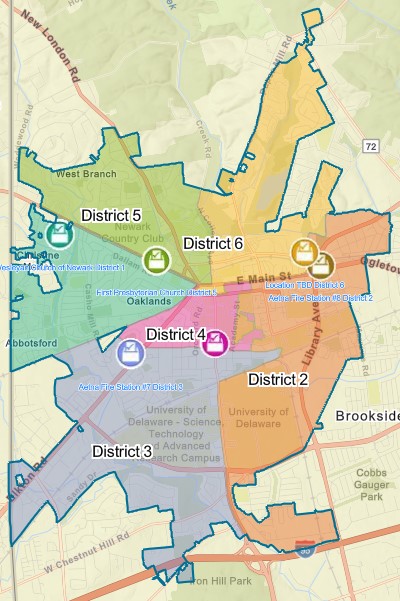
A map of Newark's six city council districts.
Map source: https://cityofnewarkde.maps.arcgis.com/apps/instant/sidebar/index.html?appid=bb034a90a75e43fb81f483711e19e84e

Let’s start at the very beginning—a very good place to start: District 1, in West Newark, a roughly triangular district bounded by Route 273, the CSX Railroad, and the Maryland border.
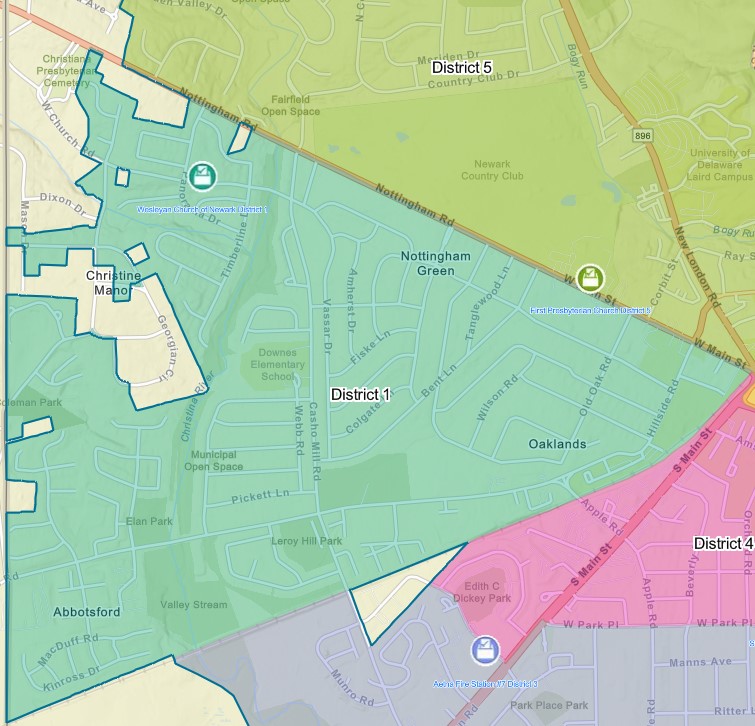
A map of Newark's city council District 1.

District 1 has seven city parks: Hillside Park, Margaret Allen Memorial Park, Norma B. Handloff Park, Leroy C. Hill Park, Rahway Park, Elan Park, and Coleman Park.
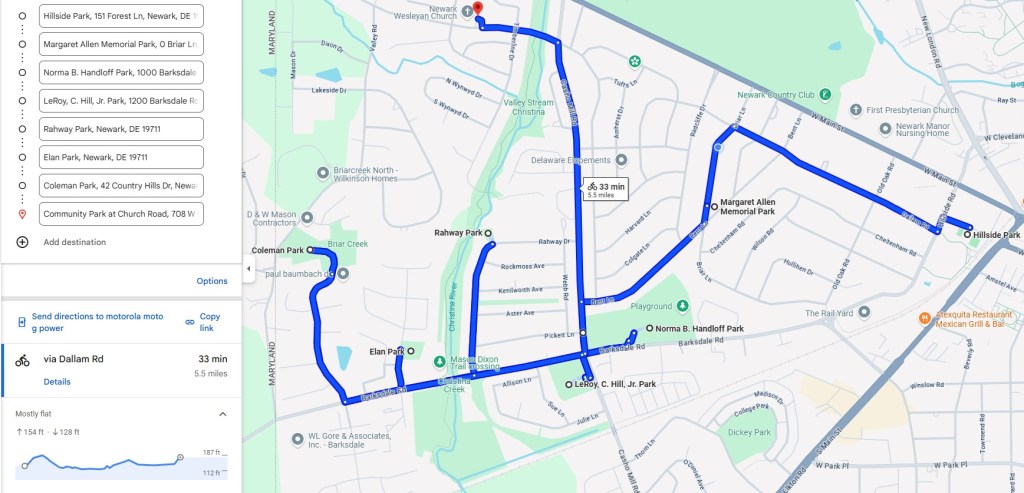
A Google Maps bicycle route 5.5 miles long connecting eight parks in District 1.

Hillside Park

Hillside Park.
One entrance to Hillside Park, at the intersection of Hillside Road and Dallam Road

One of Newark’s newest parks, Hillside Park was first conceived as a stormwater-management facility, replacing the University of Delaware’s Caesar Rodney dorms after their closure in 2015 and demolition in 2019. Beyond a stormwater-retention pond, the park’s playground, pavilions, trees and natural spaces, bike racks, paved trail loop, and fishing pier make it a hub of west Newark. On any nice day it’s bustling with kids, parents, students, townies, bikers, walkers, fishers, and geese. (A group of them on the trail almost made me late for work one morning this spring. The geese, I mean.)
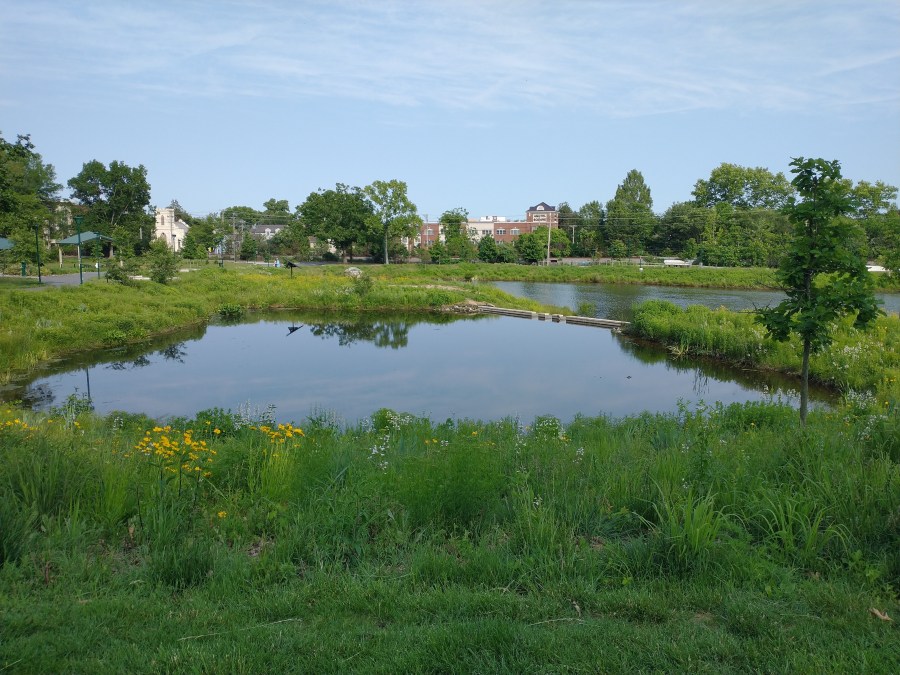
The stormwater retention pond at Hillside Park.
The pond, as seen from the trail around the park (much nicer than the term “stormwater-retention pond” might suggest)

The paved trail through Hillside Park is also a keystone of Newark’s West Bikeway, connecting neighborhoods like Oaklands and Nottingham Green to downtown Newark via the railroad underpass that leads to Amstel Avenue.
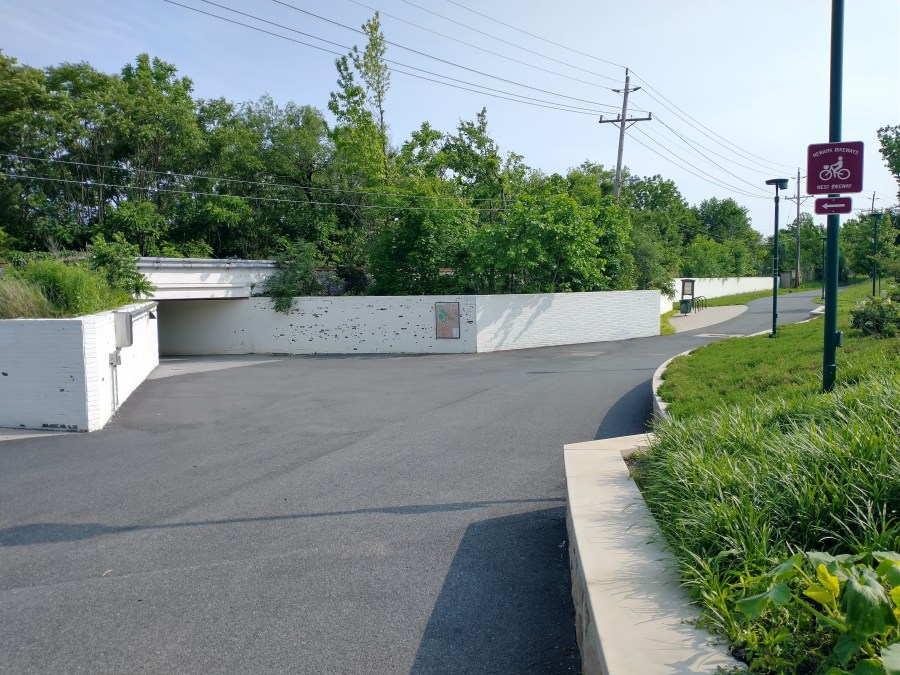
The paved trail and railway underpass at Hillside Park.
Cycling tip: Don’t ride your bike as fast as you can through Hillside Park, downhill, toward this underpass. One day you may be surprised by someone coming through the other way that you didn’t see until the last second, brake hard to avoid running into them, and fling yourself off your bike and onto the asphalt, hypothetically.

To mark its Bikeway status, Hillside Park has one of BikeNewark’s four information kiosks, containing a map of the Newark Bikeways, a map of recreation amenities in and around Newark, and a QR link to bicycle resources.
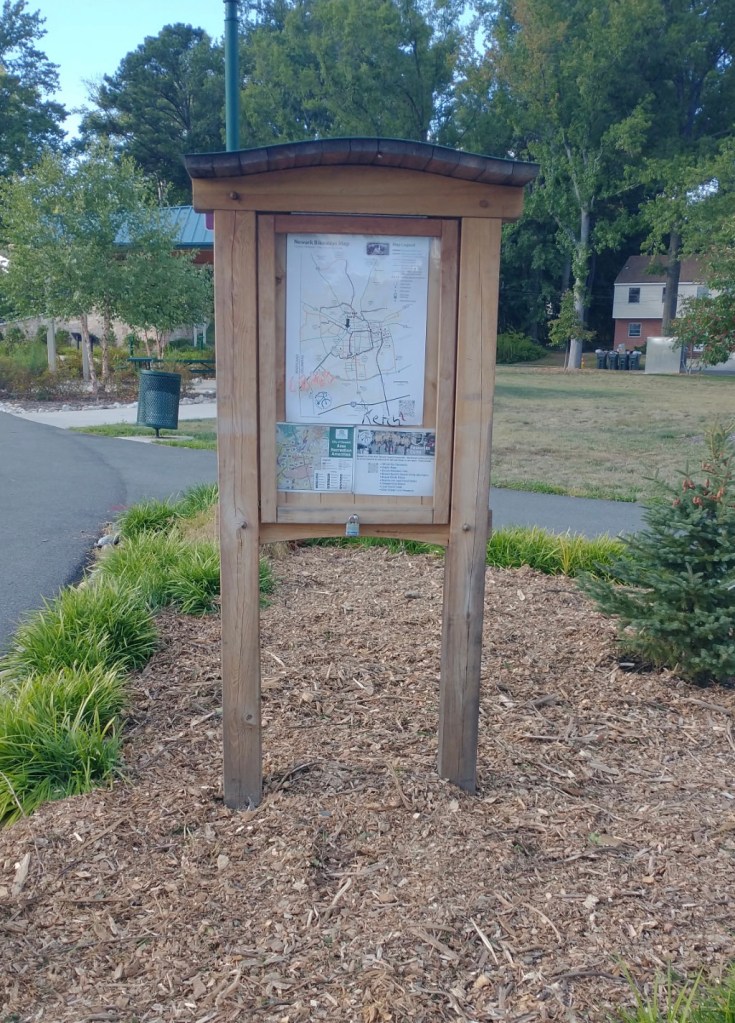
photo of kiosk in Hillside Park
Here is the information kiosk along the West Bikeway in Hillside Park, one of four such kiosks along Newark Bikeways segments citywide.

Margaret Allen Memorial Park

The trip from Hillside Park to Margaret Allen Memorial Park is an easy one. Take Dallam Road (another component of the West Bikeway) and turn left at Briar Lane (or Bent Lane, if you prefer—either will get you there).
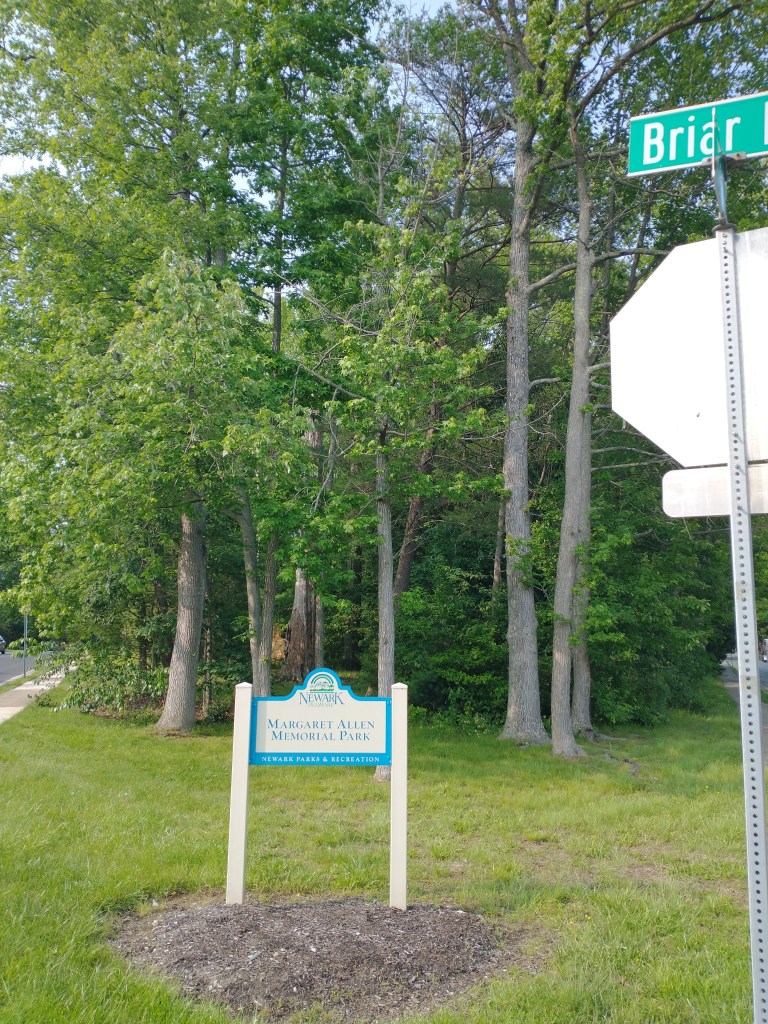
Margaret Allen Memorial Park. There are no paths or roads leading into the park.
The entrance, of sorts, to Margaret Allen Memorial Park

Many of Newark’s parks aren’t your typical playground-and-picnic table recreation space, but natural areas where trees and wildlife can flourish without any more disruption than the occasional dirt trail. Margaret Allen Memorial Park is one such park, and as far as I can tell, it’s also Newark’s smallest park, less than half an acre in area. It’s a patch of forest, taking up the tip of one of the narrow triangular wedges formed by the intersection of Bent Lane and Briar Lane.
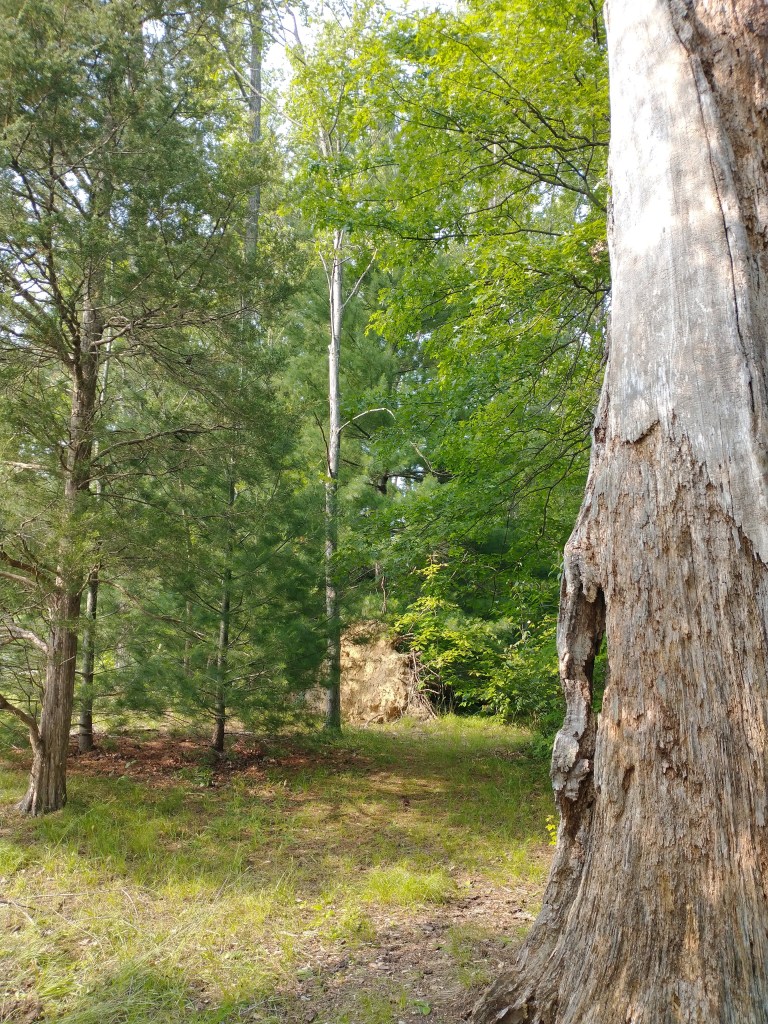
Trees and some open space at Margaret Allen Memorial Park.
Inside the park, there’s maybe a hint of the beginnings of a dirt trail.

The park’s namesake, Margaret Allen, was a Newark resident who donated the land to the City of Newark to be preserved as parkland rather than being developed. The park was named after her in 2023, 24 years after her donation of the land and 16 years after her death.

Norma B. Handloff Park

The trip from Margaret Allen Memorial Park to Norma B. Handloff Park is short, but does require a few tricky left turns. Keep going southwest on Bent Lane, then turn left onto Casho Mill Road, then left onto Barksdale Road. Continue along Barksdale and turn left into either of two parking lots.
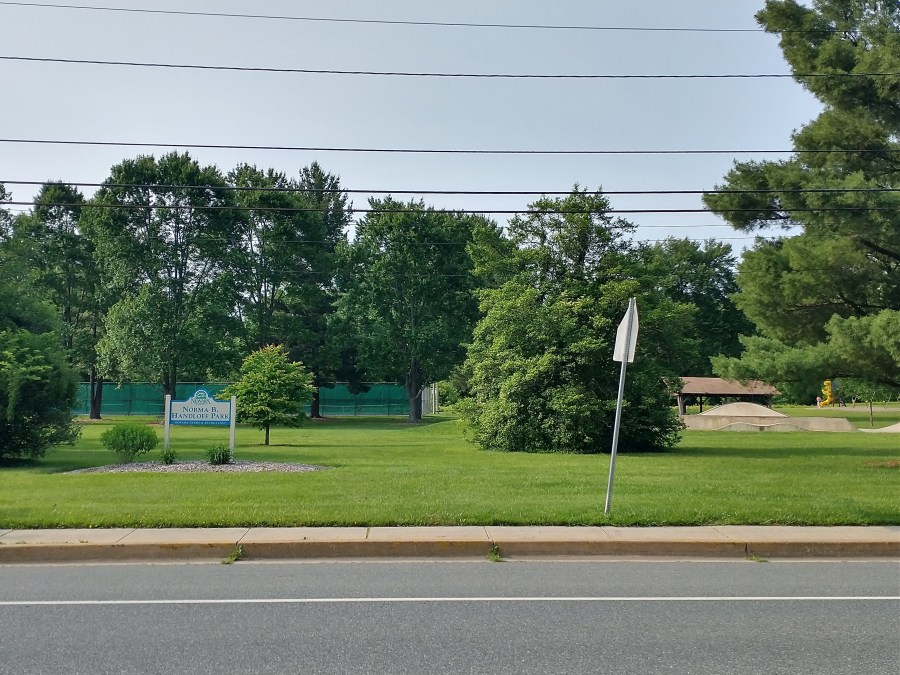
Norma B. Handloff Park.
From the view of the sign at Norma B. Handloff Park, you can see the tennis courts, the pavilion, the skate spot, and a slide in the distance. And this isn’t even half of it!

Norma B. Handloff Park was one of the parks I visited most growing up in Newark, and let me tell you, this place has everything—tennis courts; baseball fields; basketball courts with a handball wall; at least eight playsets, swing sets, slides, and other play features, the names of which I don’t even know; the tire swing that was a yearly highlight of the Summer Playground summer camp program; and pavilion with multiple picnic tables! It boasts one of only two skate spots in the city of Newark!
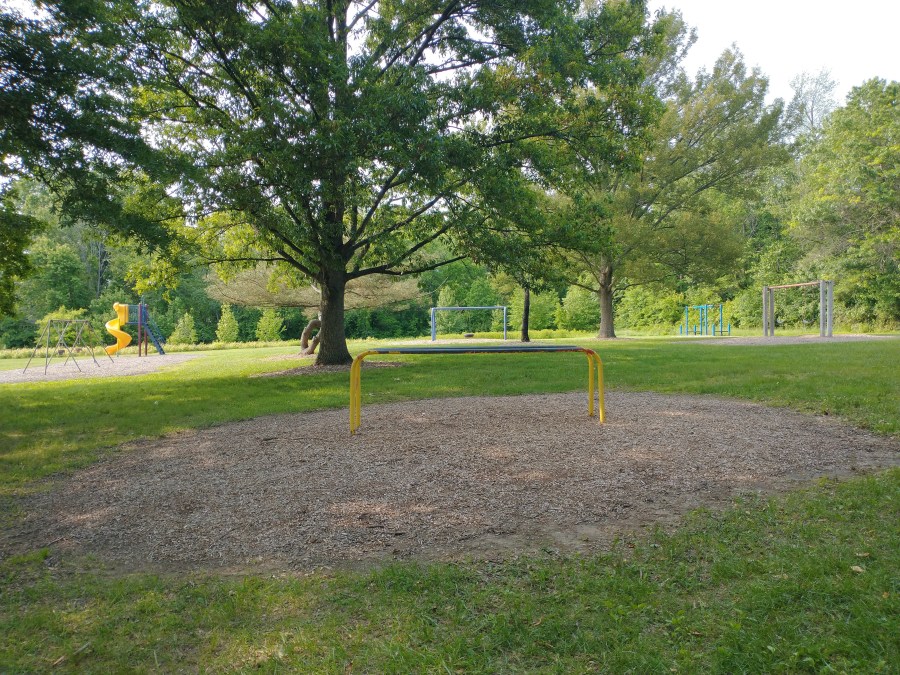
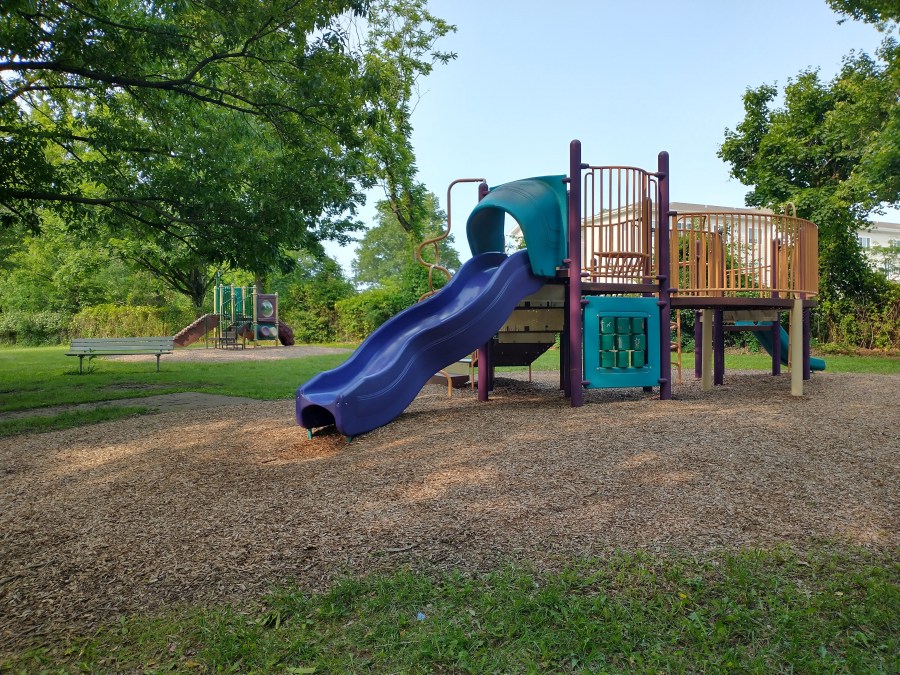
A slide, two swing sets, a tire swing, and other small play features at Norma B. Handloff Park.
The beloved tire swing is in the center background.
Two play structures, each with multiple slides, at Norma B. Handloff Park. No people are visible.
These pictures make the place look empty, but there were plenty of kids all over the park the day I visited.

And still, there are huge swathes of open space and many, many trees. (Sadly, the weeping willow tree that gave shelter to Summer Playground campers for years seems to have gone the way of the program itself.) The City’s website also assures me that there’s a new rain garden at the park, though I wasn’t able to see it for myself.
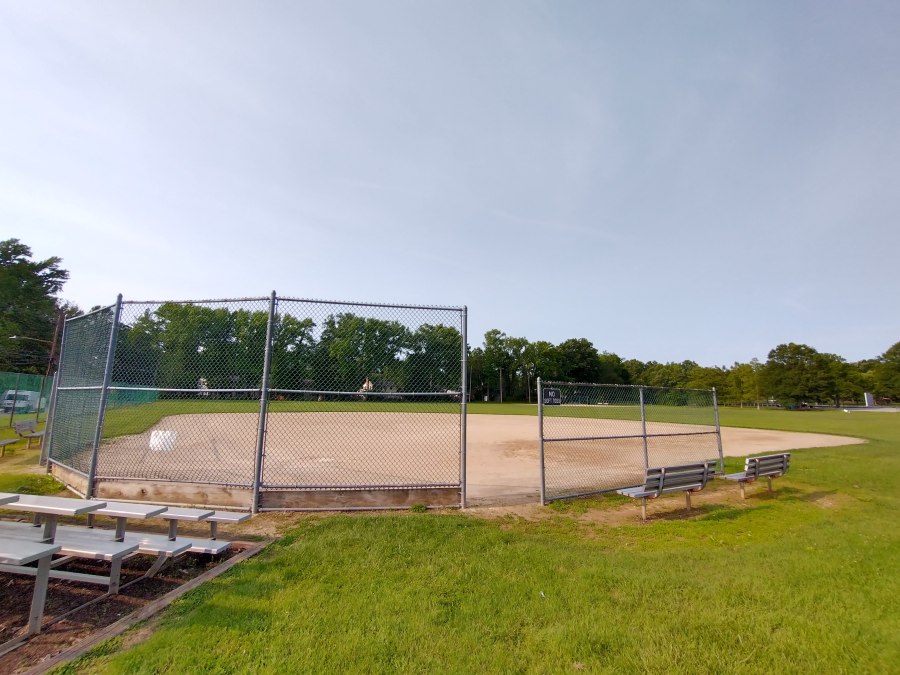
A baseball field at Norma B. Handloff Park.
This is one of two baseball fields at the park, seen from the corner of Barksdale Road and Casho Mill Road. The other baseball field is just barely visible in the background.

The park’s namesake, Norma B. Handloff, was Newark’s first female mayor, who served from 1967 to 1973 and worked to improve the city’s parks. Fittingly, the park is the site of many city events and classes, including the Parks on Draft concert series and the annual Turkey Trot race.

Leroy C. Hill Park

The trip from Norma B. Handloff Park to Leroy C. Hill Park is even shorter. Head back down Barksdale Road, turn left onto Casho Mill Road, and the parking lot is on your right. You might spend longer waiting at the light than you will riding.
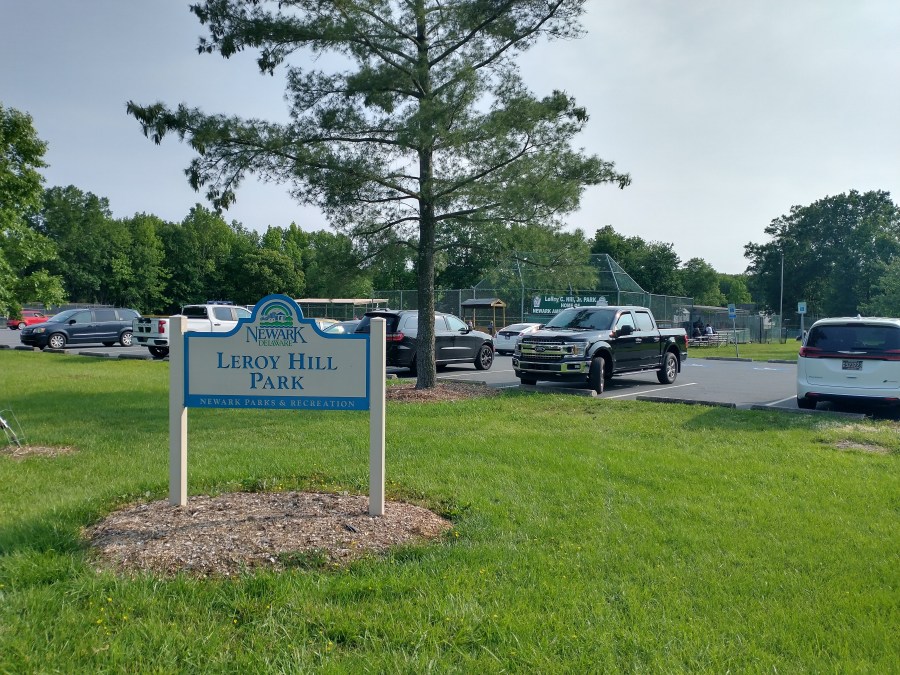
Leroy C. Hill Park. The City of Newark sign says Leroy Hill Park. A Little League banner says LeRoy C. Hill, Jr. Park.
The sign, parking lot, and backstop at Leroy C. Hill Park

The baseball field at Leroy C. Hill Park is one of the home fields of the Newark American Little League, and also hosts some of Newark Charter High School’s baseball games. What else is at the park, you may ask? Well, there’s a parking lot.
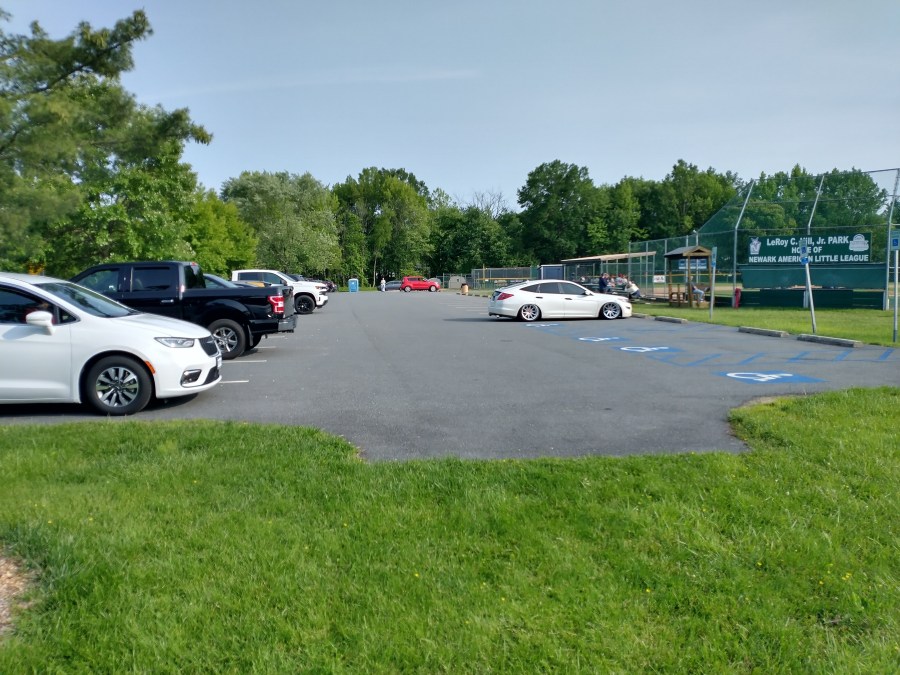
The parking lot at Leroy C. Hill Park.
It’s kind of incredible to me that a Little League baseball field in a small town surrounded by residential neighborhoods has this much car parking and not a single bike rack.

If you’re at Leroy C. Hill Park and you’re not playing or watching baseball, you could: search for a place to lock up your bike; contemplate the fact that the nearest baseball field, directly across the intersection at Norma B. Handloff Park, is less than a tenth of a mile away; or check out the Little Free Library, the first so far on the Newark Park Tour! Unfortunately, when I checked out this Little Free Library, it was full of ants.

Little Free Library Running Total: 1 (District 1) / 1 (All Districts)
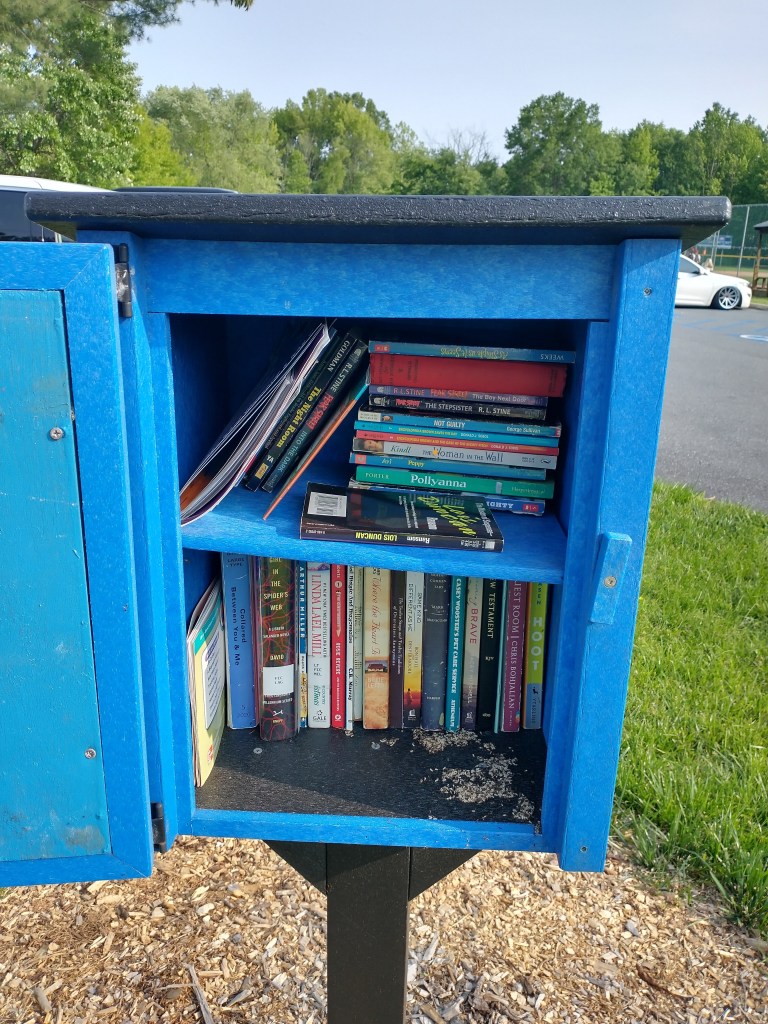
The Little Free Library at Leroy C. Hill Park. Pollyanna and some R.L. Stine books are on the top shelf. A cluster of ants is on the bottom shelf.
You see the stuff that looks like rice on the bottom shelf? Those are ants. They have wings. Seems more R.L. Stine than Pollyanna to me.

The park’s namesake, Leroy C. Hill Jr., was a Newark resident who was thoroughly involved in baseball at the local and national levels. To quote his obituary in the Newark Post:

Hill managed baseball teams for Newark High School and town teams prior to WWII and played in the Susquehanna League afterwards. He also managed Wilmington Truck Body in the Delaware Semi Pro League and the Newark Buccos in the Vic Willis League. He was a professional baseball scout for the Phillies and the Pirates and was a founding member of the Mid Atlantic Major League Baseball Scouts Association. Hill was most proud of his being able to help Vic Willis make it into the Baseball Hall of Fame in Cooperstown, N.Y.
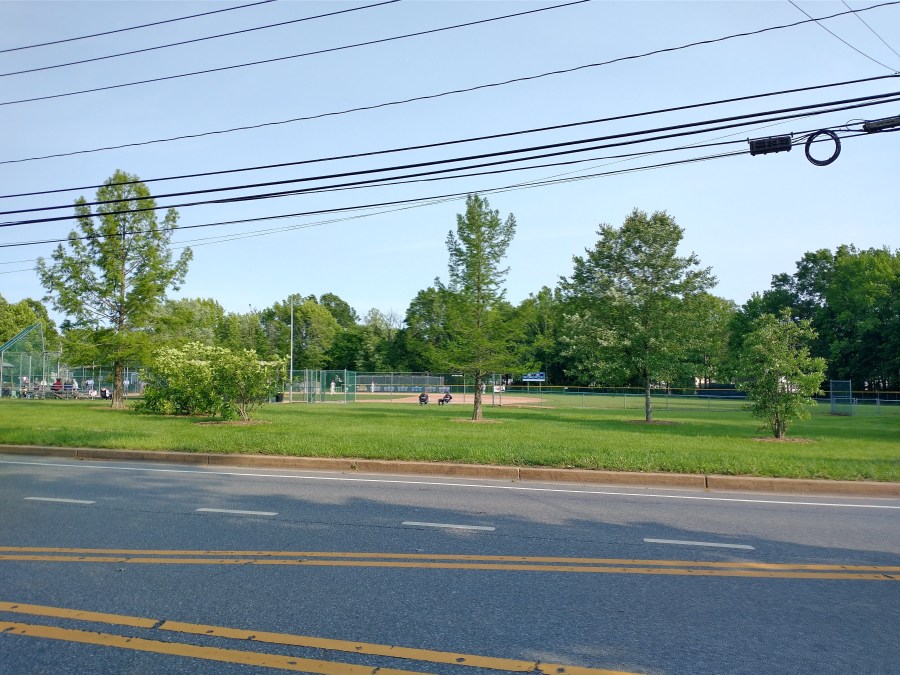
The baseball field at Leroy C. Hill Park.
The baseball field at Leroy C. Hill Park, as seen from Barksdale Road, en route to Rahway Park

Rahway Park

The trip from Leroy C. Hill Park to Rahway Park requires you to turn left onto Casho Mill Road, for the third and final time this trip, then left onto Barksdale Road, then right onto Rahway Drive. Keep riding until you reach the right-angle bend in Rahway; the park will be on your left.
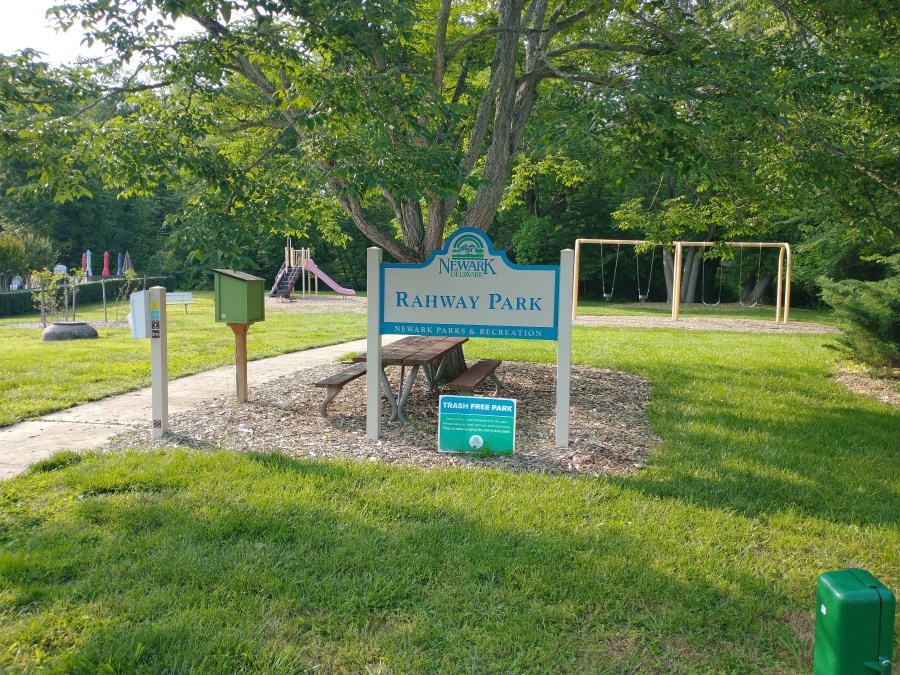
Rahway Park.
This is Rahway Park, yes, the whole thing. Part of a neighbor’s yard, too, is off to the left.

Rahway Park probably qualifies as a pocket park; it’s a small neighborhood park, less than an acre, on a single residential lot between two houses. One swing set and one play feature. (The latter was removed a few weeks after I took this picture, according to the City, and should be replaced soon.) One picnic table, one very climbable-looking tree (sadly, I did not have the time to test this myself), one park bench, and one exhortation to take your trash with you… and one Little Free Library!

Little Free Library Running Total: 2 (District 1) / 2 (All Districts)
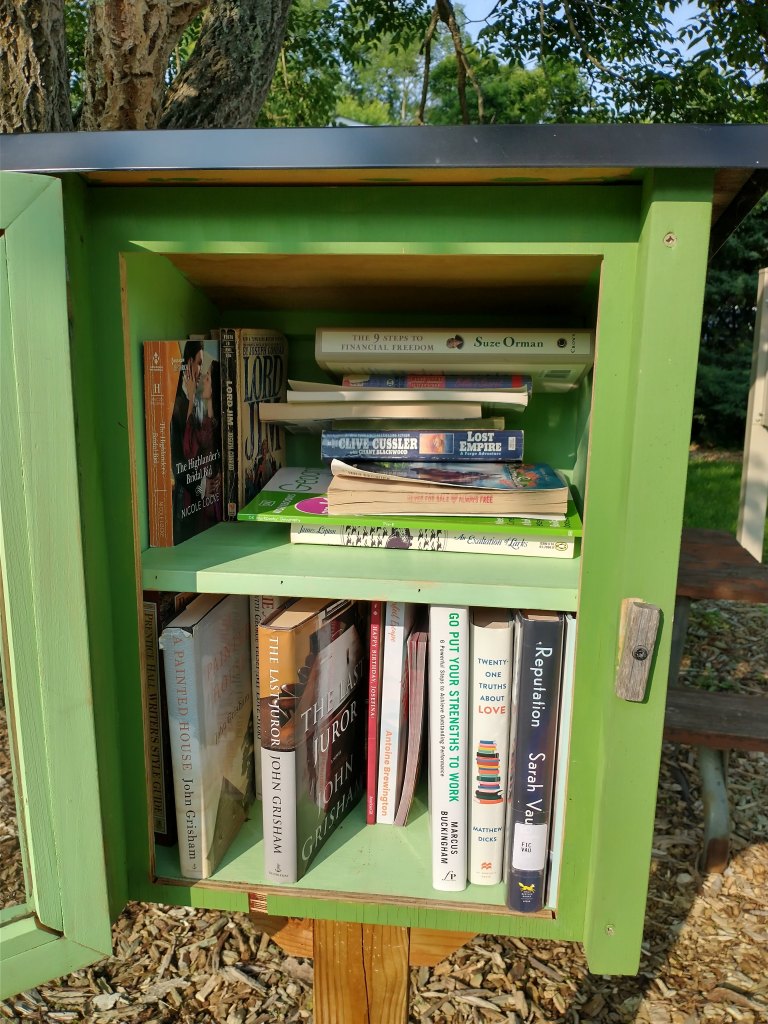
The Little Free Library at Rahway Park. There are multiple John Grisham books on the bottom shelf.
This one had far fewer ants and somewhat more John Grisham.

Elan Park

The trip from Rahway Park to Elan Park takes you back down Rahway Drive the way you came, right onto Barksdale Road, and right into Blue Hen Ridge. Slog your way up the hill, and you’ll be rewarded by the park on your right.
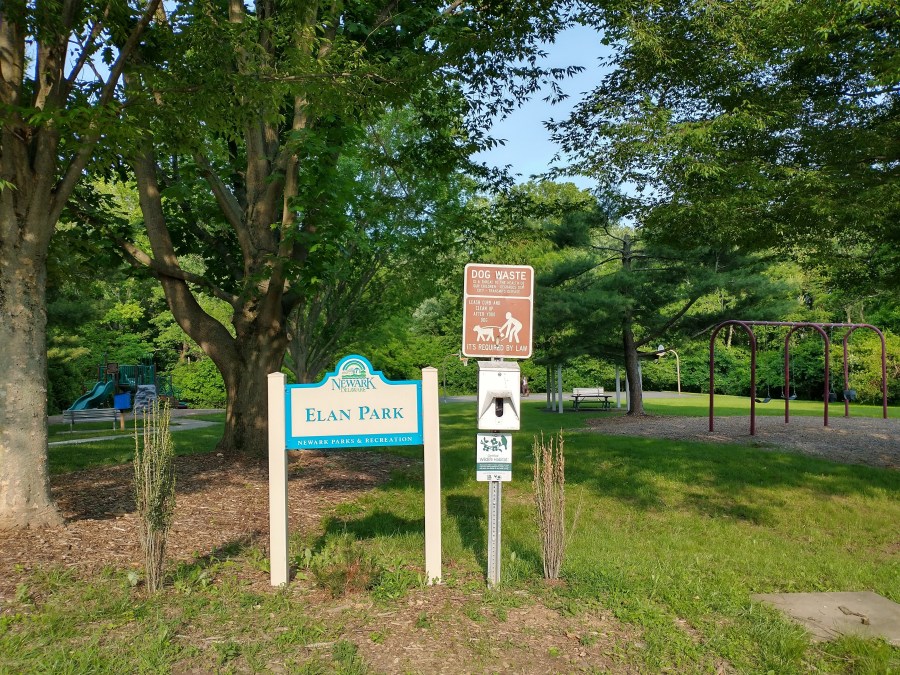
Elan Park.
Here’s the sign and most of the features at Elan Park. Most of the grassy space isn’t captured in this picture.

Elan Park is a neighborhood park, not unlike Rahway Park, but a little bigger and a little fuller (A backpack park, if you will, rather than a pocket park), with one swing set and one play feature, the latter being more elaborate. There are one picnic table under a pavilion, several trees, a Wildlife Habitat certification, two park benches (at least), and a basketball court. There is only one Little Free Library, though, but I suppose more than one at a park this size would be too extravagant.

Little Free Library Running Total: 3 (District 1) / 3 (All Districts)
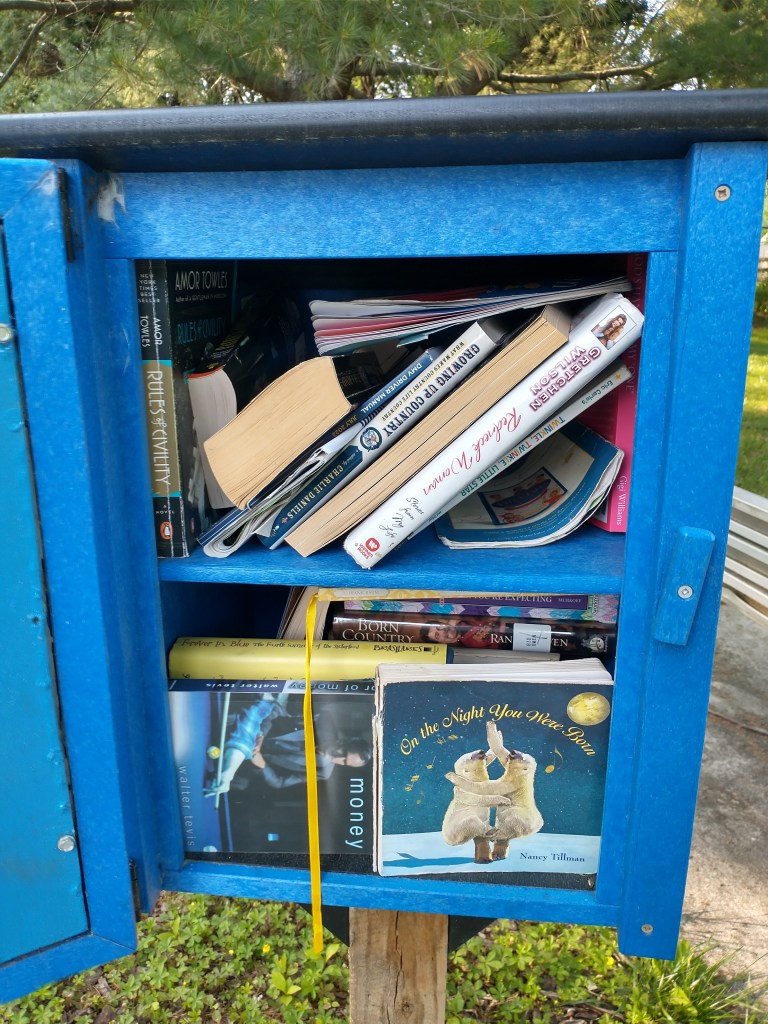
The Little Free Library at Elan Park. Rules of Civility by Amor Towles is on the top shelf.
I took Rules of Civility off the top shelf about ten seconds after taking this picture. I’d already read and enjoyed Amor Towles’ other novels.

The source of Elan Park’s name is hard to track down. The nearby neighborhood of Country Place, which has a sign at the intersection of Blue Hen Ridge and Barksdale Road, actually only includes the townhouses on Chickory Way. The Newark zoning map claims that houses on Blue Hen Ridge and its offshoots of North Fawn Drive, South Fawn Drive, and Squirrel Lane belong to the Hunting Hills subdivision, but also assigns some of them to the community of Elan of Huntington Hills.
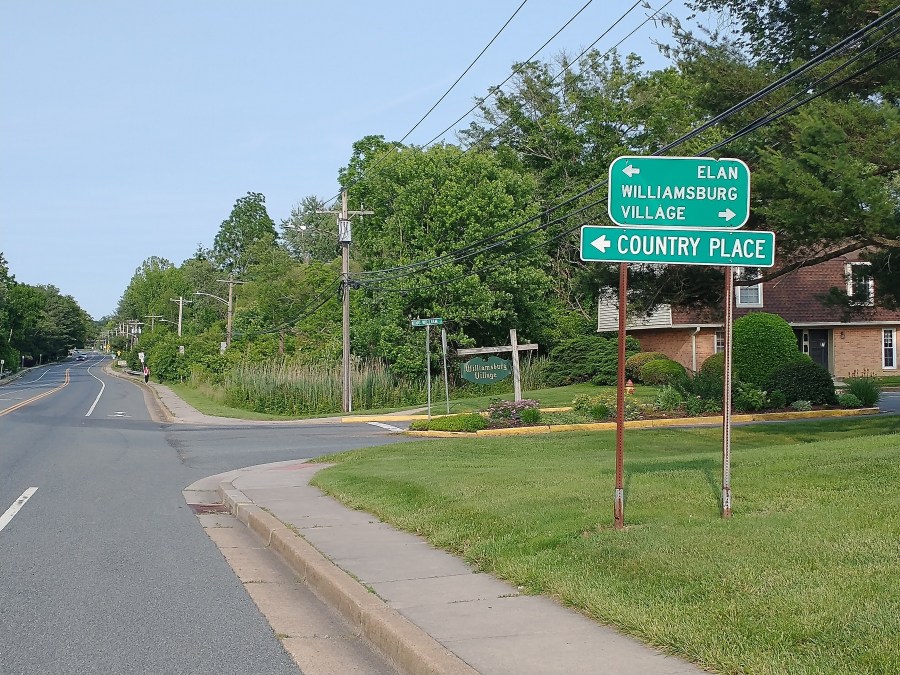
Two road signs off Barksdale Road, pointing out three neighborhoods: Elan and Country Place to the left, and Williamsburg Village to the right.
This set of signs from the other side of Barksdale Road clarifies nothing.

Coleman Park

The trip from Elan Park to Coleman Park starts by riding back down Blue Hen Ridge and right onto Barksdale Road yet again. Then turn right onto the aptly named Country Hills Drive and ride all the way to the end. Make sure you brought a bike with gears, or a battery.
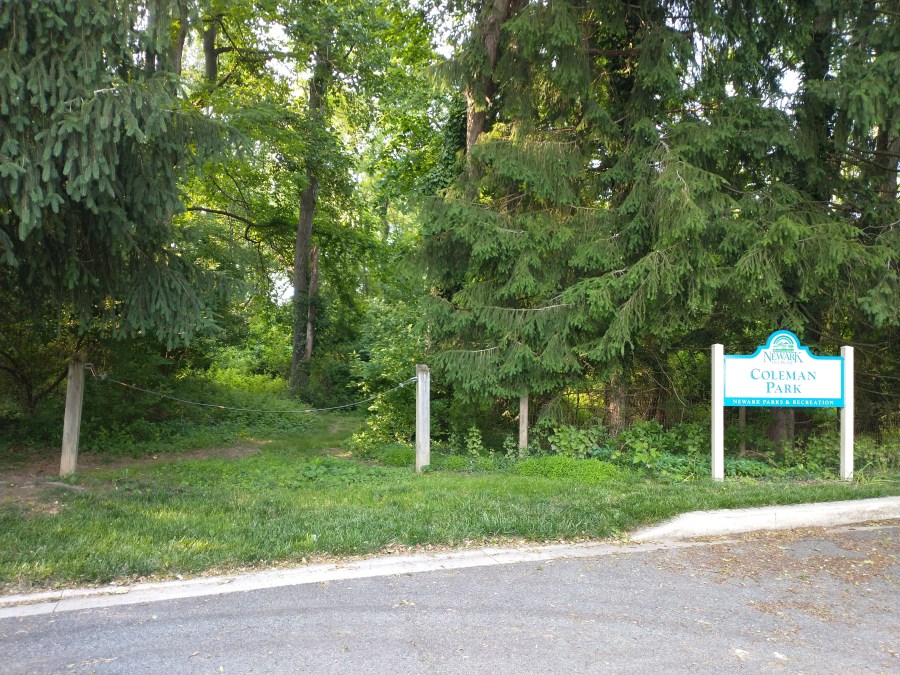
Coleman Park. The trail entrance is roped off.
This is the sign at Coleman Park and entrance on Country Hills Drive. Note that the entrance is not usually roped off.

Coleman Park is another “natural area and dirt trails” park, though much larger than Margaret Allen Memorial Park. The trail runs from Country Hills Drive through the woods to Valley Road, just a few feet from the Maryland border, and not far from the Briarcreek North neighborhood. At the time of my visit, and the time of writing this, Coleman Park was closed indefinitely for safety reasons. From the Newark Post:

The inspection found that the tree canopy near the entrance to the park consists of many black locust trees that are structurally compromised by fungal decay and pose a significant risk of falling.

The walking paths are eroded and surrounded by dense thickets of greenbrier, multiflora rose and poison ivy.

“These thorny species have overgrown the area and become entangled with large woody debris from fallen trees and limbs,” City Manager Tom Coleman wrote in a memo to city council. “Significant land clearing and tree removal must be completed before we can reopen the park.”

The city does not have funding for such work in the 2025 budget, according to Coleman, who did not provide any indication as to when the park might reopen.
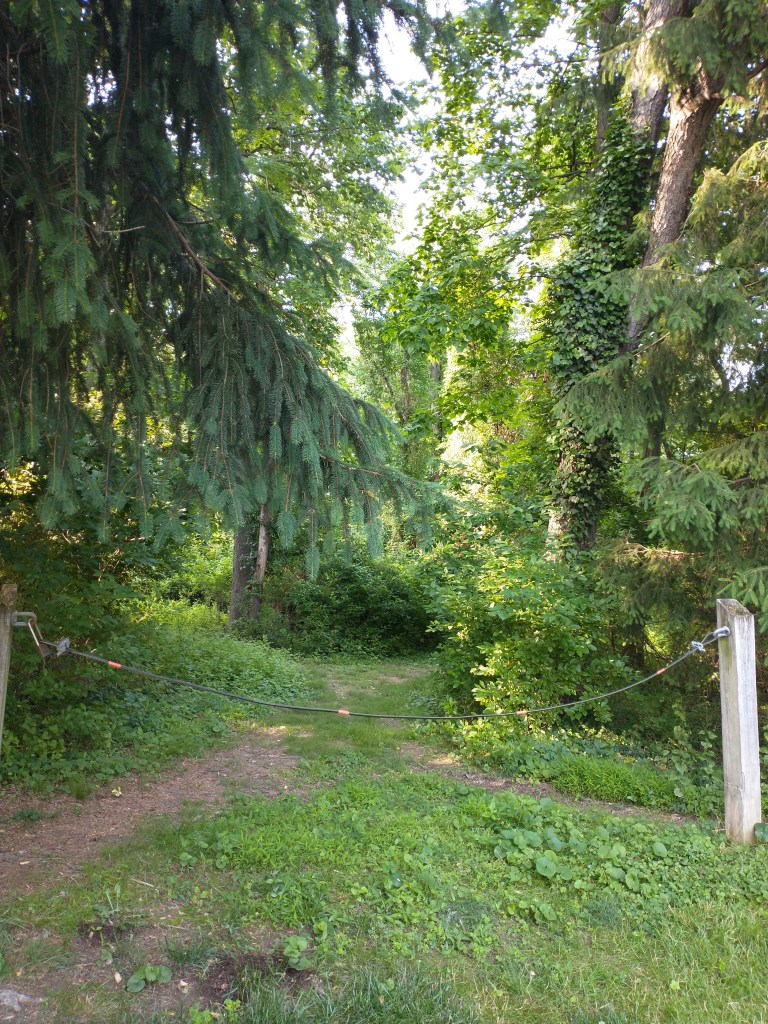
The trail and trees at Coleman Park.
This was about as close as I could get to the park.

The Newark Post article also contains two further pieces of information about the park: 1) it was purchased and annexed by the city in 1993 and named for the family that used to own it (no relation to the City Manager), and 2) possible future improvements to the park include paving the trail and adding a turf/meadow area. I’ll leave it to residents of the adjacent neighborhoods to decide whether or not these changes would improve the park.

If the trail through Coleman Park were open, the trip to the final park on the list would use it. Instead, you’ll need to ride back down Country Hills Drive, turn left on Barksdale Road and ride half a mile, turn left again on Casho Mill Road and ride three-quarters of a mile, turn left again on West Church Road, and ride up the hill until you spot the park on your right.

BONUS: Community Park at Church Road
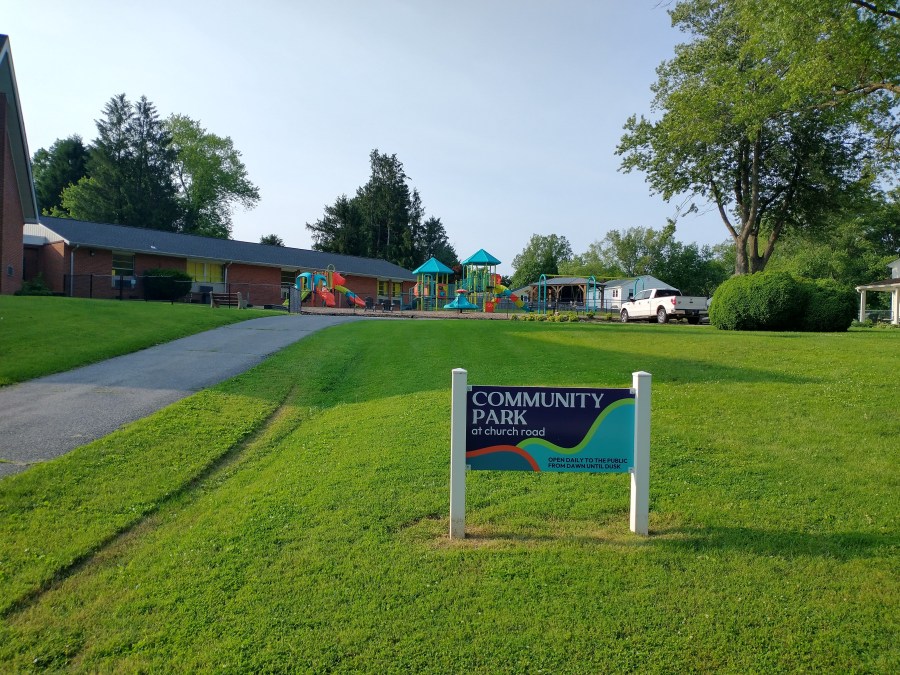
The Community Park at Church Road, with the park sign in the foreground.
This is the entrance to the Community Park at Church Road. The playground, pavilion, and church are there in the back.
  • Location: 708 West Church Road
  • Bike parking spaces: 0

The Community Park at Church Road isn’t a City of Newark park, hence the “bonus” status. It’s the property of Newark Wesleyan Church, seen here, but open to the public from dawn to dusk every day. The park, which was opened to the public in the fall of 2024, includes multiple play features, a swing set, a pavilion with two picnic tables, and several park benches and chairs.
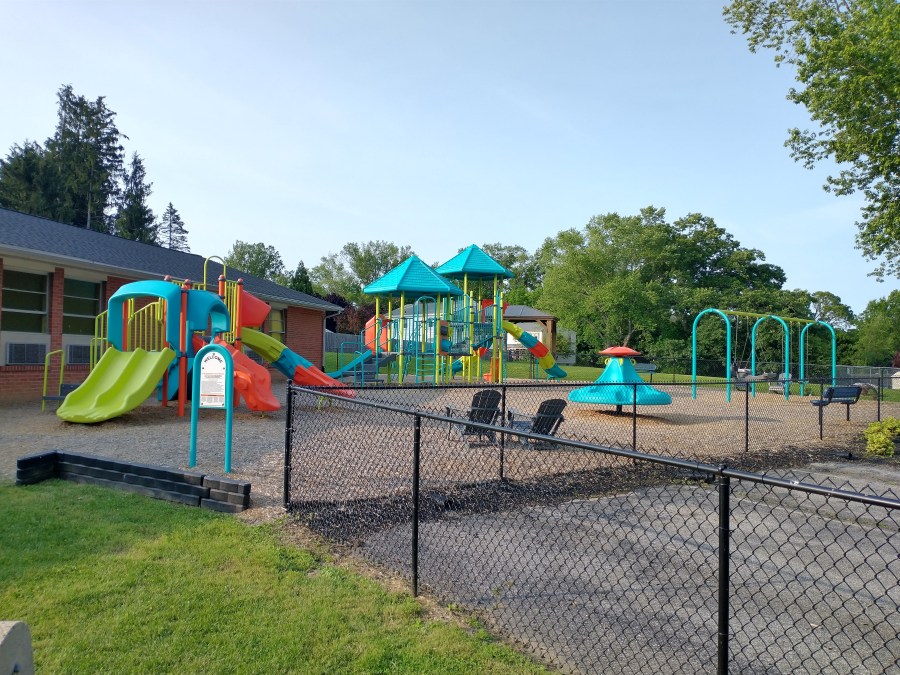
The playground at the Community Park at Church Road.
Here’s the playground, a little closer up. I’m intrigued by that spinner and the unusually-shaped swing.

District 1 residents may also know Newark Wesleyan Church as their polling place for city elections, such as the elections for mayor and District 1 councilmember held earlier this year. You all voted in that, right?
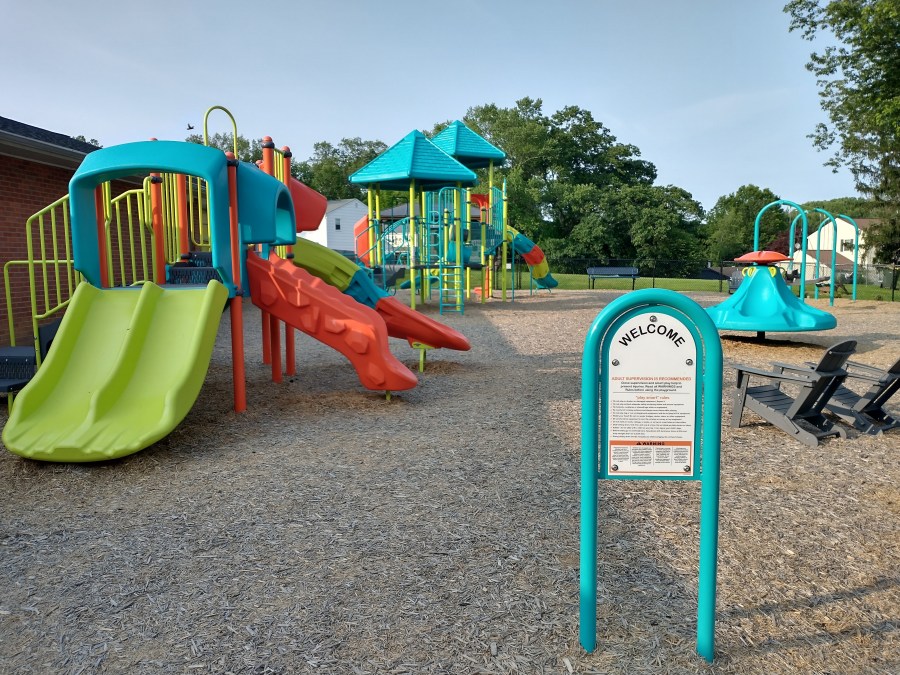
A closer view of the playground at the Community Park at Church Road, with a Welcome sign in the foreground.
Here’s a shot of the playground from inside the fence. The sign did say I was welcome, after all.

That completes the tour of District 1’s parks! Next time I’ll be exploring the parks in District 2.
How I celebrated National Bike Month: Bike to Work Day and The Commuter Challenge


by Jacquee Lukawski

photo of Jacquee Lukawski

National Bike to Work Day occurs annually on the third Friday in May. BikeNewark, and several of its partner organizations hosted Bike to Work Day in Newark on the morning of May 16. The event featured breakfast food, speakers representing local or state entities, random giveaways to registered attendees, and the Bicycle Friendly Community Leader Award, which was presented to Delaware State Senator Dave Sokola. I was fortunate enough to win free registration to the Amish Country Bike Tour in Dover, Del., for the second year in a row!

On Bike to Work Day, I do not ride my bicycle all the way from North Wilmington to Newark but combine biking with a SEPTA regional rail trip. Someday I hope that there will be sufficient infrastructure to enable me to ride my bike to work, but as of right now, it’s not safe to do so. To accomplish my multimodal commute, I use two bikes—one that I ride to the Claymont SEPTA Station and the other that I keep parked at the Newark Train Station. Both bikes are inexpensive and secured with u-locks. While I have taken my bike on the train before, I don’t find it to be a pleasant experience, so I try to avoid it. Maybe in the future I’ll sell a bike or two and buy a folding bike that would be much easier to transport via the train. 

photo of Jacquee Lukawski biking up Monkey Hill cobbletones
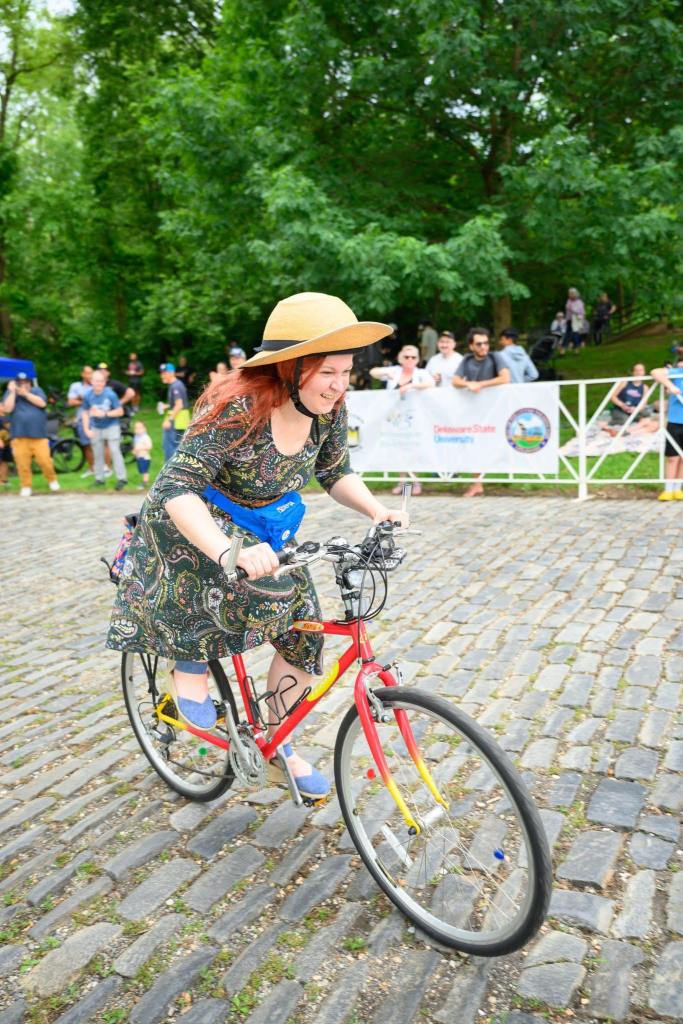
Jacquee Lukawski battling up Monkey Hill (photo by Joe Del Tufo, Moonloop Photography)

Each year for the past three years, I have also participated in the Commuter Challenge division of the Monkey Hill Time Trial, which is the event that kicks off the Wilmington Grand Prix, held each year on Bike to Work Day. This is a three-mile ride through Brandywine Park in Wilmington, ending on a steep climb up the cobblestones of Monkey Hill, adjacent to the Brandywine Zoo. The Commuter Challenge is a fundraising event for Urban Bike Project of Wilmington—the sister organization to Newark Bike Project (one of BikeNewark’s seven partner organizations). It features competitors dressed up in costumes and carrying extra weight on their bikes; it’s truly entertaining and a great time! 

This year, I got caught up in the cobbles and ended up running off the course midway up the hill. I was able to get started again and successfully made it up the hill with the crowd going wild for my outfit—a dress (which I made myself), high-heel wedge shoes, and a straw hat over my helmet. Most people could not believe that I would wear those shoes, and, indeed, most sane people would not do so, but it was my milestone after raising $500 for the cause. My feet are still recovering from blisters several days later, but the memories are worth it!

Editor’s note: Jacquee Lukawski is a University of Delaware Department of Civil, Construction & Environmental Engineering staff member and currently BikeNewark’s Secretary.

Euro bike bliss: Swedish Kattegattleden bike trip

by McKay Jenkins

My family and I were just a few kilometers into our bike tour up the west coast of Sweden when we pulled off for lunch beside a two-window shack in the tiny fishing village of Domsten. It was there, biting into a piece of smoked mackerel—caught by the proprietor’s husband in that very bay—that we knew were in for a special week.

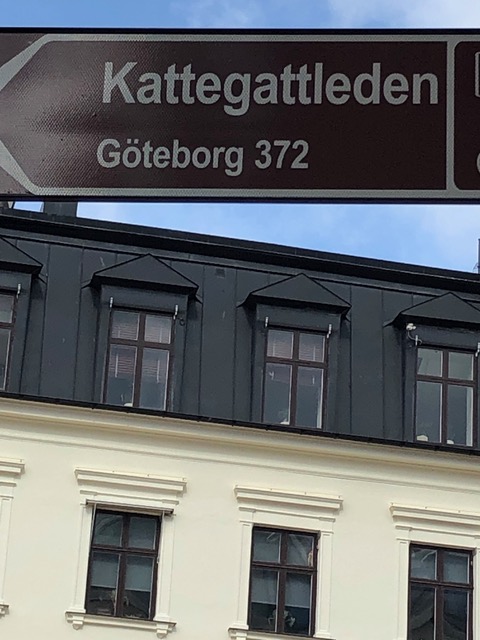
photo of route signMy wife’s maternal family has lived in western Sweden for hundreds of years, and this bike trip would take us 400 kilometers (250 miles) from the city of Helsingborg north to Gothenburg, her family’s hometown. Riding a bike into her ancestral city was something Katherine had wanted to do for years, and now that our kids were 18 and 15, we were finally doing it.

The ride followed the Kattegattleden route, named for the enormous bay it rims. It began just across the water from Helsingør, Denmark, site of the castle in which Shakespeare set his play Hamlet. The route runs almost entirely on paved (and dedicated) bike trails, along wooded gravel paths through nature preserves, or along virtually untraveled country roads.

photo of bikers on the Kattegattleden route in SwedenI have done a lot of bike touring over the years. I’ve ridden 800 miles down the Pacific Coast, along the Icefields Parkway in the Canadian Rockies, across New England from Maine to New York, across Virginia and Montana, and at length in both France and Quebec. Never in all my bike-touring career have I seen such a magnificently laid-out bike route. Only once or twice a day would we find ourselves pedaling beside a busy road, and this was always with a concrete barrier between us and the cars, and never for more than a few hundred yards.

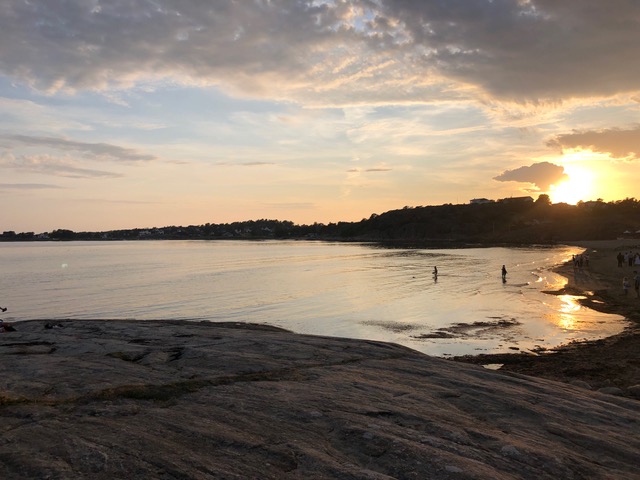
photo of sun over the horizon at seasideThe eight-day route followed the west coast of Sweden, weaving between tiny fishing villages; small-scale farms growing potatoes, wheat, and Swiss chard; and at least 400-year-old towns with cobblestone streets and outdoor cafes. The distances between inns ranged from about 40 to about 65 kilometers—roughly 25–40 miles—per day. Given the terrain’s nearly entirely flat profile, these distances never seemed too long, with one exception: one of the longer days featured a strong northerly wind, which we battled for about five hours.

The east coast of Denmark was visible off to the west for the first day but then gave way to the vast Kattegat Sea separating the two Nordic countries. Along the way we happened upon an array of surprises.

  • In Bastad, we rode straight onto the grounds of the Swedish Open tennis tournament, which offers free admission.
  • In Gothenburg, we took in the Gothia Cup, the largest youth soccer tournament in the world, featuring some 1,700 teams from around the world. Admission here was free as well.
  • In between we happened upon a Mackerel Festival in the town of Bua, lining up with hundreds of others to sample local fish and (apparently famous) Bua pudding.

Truth be told, we seemed to spend as much time eating as we did biking. The Swedes are known not just for their love of fish but for their seemingly bottomless appetite for caffeine and sweets during their daily “fika,” or late-afternoon coffee breaks. Our photo album has as many images of cardamom buns and chocolate cakes as it does tidy red cottages or village harbors.

Even in the cities, bikes and bike paths were everywhere. Scandinavia, like much of Europe, has been far more ambitious that the United States in its creation of bicycle infrastructure.

Part of this has been made easier by European land-use planning. Most cities are far older than cars, after all, and (at least as importantly) much of the countryside never suburbanized. Many older cities were initially designed to accommodate foot- and horse paths, which (as many American drivers have discovered) have always felt too narrow for car traffic.

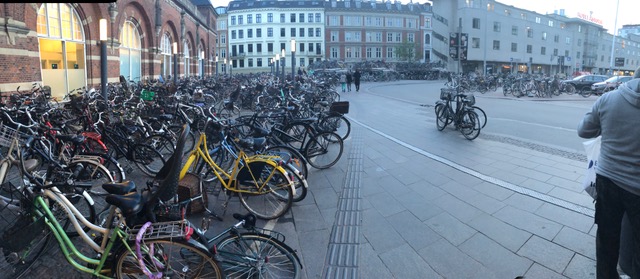
Visit Copenhagen, as we did before setting off on this journey, and you will be astonished at the numberless thousands of bicycles jammed together near the city’s central train station. In town, biking is simply the most sensible way to get around.

photo of bicycles in Copenhagen, Denmark

Out in the country, small farms still dominate the landscape, and country roads, while built for cars, are not (with the exception of thruways) built for suburban commuter traffic. Out on our bikes, we passed the occasional tractor, but never did we feel threatened by angry commuters. Even in the country, bikes are the rule rather than the exception.

The bike tour was simple to set up. We organized the trip through a company called Gyllene Turer (gylleneturer.se), run by the very helpful Jesper and Britt-Marie Rothstein, who also provided an excellent book of maps. Gyllene Turer set up the whole trip for us. They secured bikes for us, arranged luggage transport, and arranged bookings in all of the hotels. The bike path has its own website kattegattleden.se, through which one can find a link for luggage transport and links for organized bike tours, one of which is Gyllene Turer.

The route was incredibly well marked, with signs at every crossroads or important turn. This was a “supported” tour, meaning that drivers from the company picked up our backpacks at our inn each morning and drove them to our next stop, saving us the struggle of carrying 30 extra pounds of food and gear.

Staying in inns and bed-and-breakfasts also saved us the trouble of carrying tents, sleeping bags, and cooking gear. As someone who has carried his own gear on a number of long bike trips, I have come to appreciate the beauty of a warm bed, a hot meal, and a light bike. The fact that I am in my 50s and not my 30s may also have something to do with this. And I think it’s safe to say that telling my teenage kids that there was a hot tub waiting for them at the end of most days didn’t hurt!

Bike to Work Day 2017

Bike to Work Day 2017 group photo

Bike to Work Day 2017 sponsor logosNewark’s celebration of National Bike to Work Day, by all estimates, was a big success, drawing nearly 120 riders to Mentors’ Circle on the University of Delaware campus for the early morning event.

The warm, sunny weather definitely helped increase the participation in this event from previous years, as did the great support in terms of sponsorship from the business community, which furnished the food and prizes for the random giveaways.

Several of the featured speakers rode in, each with one of several area “bike trains.” The largest and most impressive bike train was that of Bloom Energy. As University of Delaware Provost Domenico Grasso was beginning to officially welcome everyone, a group of 30+ riders from Bloom arrived, making their corporate presence known with team T-shirts.

The morning featured wonderfully encouraging bicycle-centric messages from New Castle County Executive Matt Meyer, state Sen. Dave Sokola, state Rep. Paul Baumbach, state Rep. Ed Osienski, and retiring Newark City Manager Carol Houck.

photo of Markell family with Mike Fortner and Mark Deshon
Event coordinator Mike Fortner (left) and BikeNewark chair Mark Deshon (right) presented the 2017 Bicycle Friendly Community Leader Award to former Gov. Jack Markell. Markell’s mother, Leni, and children, Michael (with award) and Molly, accepted the award on his behalf.

The City of Newark and BikeNewark presented the annual Bicycle Friendly Community Leader Award to former Gov. Jack Markell. Markell was in Italy on a bicycle trip, so his mother and children were there to accept the award on his behalf. Son Michael spoke glowingly about the influence his dad has had on him in terms of bicycling and giving back to the community.

A large group photo was organized, and then event coordinator Mike Fortner, one of BikeNewark’s liaisons from the City of Newark, made the morning especially happy for many who had stayed for the random giveaways as a formal conclusion to the morning’s festivities.

2018’s Bike to Work Day event in Newark will take place on Friday, May 18. BikeNewark looks forward to seeing you there.

Bicycling Newark in the Dark Ages: 1987–1991

photo of bicycle under Newark, Delaware, and Bicycle Friendly Community signsby Andreas Muenchow

I grew up in Germany and learned to ride a bicycle at age five. My first bicycle arrived six years later in 1972, which I used to propel myself to school every day. Arriving in 1987 in Newark as a graduate student, I bought a used bicycle to get from a rented room on Cleveland Avenue to a shared office in Robinson Hall. This was perfectly normal for me, but not common at the time.

Ann, a fellow graduate student, was the first American I saw on a bicycle. Racing past my Cleveland Avenue home, she saw me sipping coffee on the porch and stopped to say hello. She looked like an alien decked out with an aerodynamically shaped helmet, fancy clothes worthy of the Tour de France, and a wobbly walk (as her clip-ons were not meant for walking). She asked me why I was laughing at her and if I knew how to bike. Well, yes, I replied, but I do it in jeans, Birkenstocks, and a t-shirt in summer or a coat in winter. Furthermore, I bicycle to get to work or to go shopping or to transport stuff.

My second bicycle culture shock relates to dating. One day I was brave enough to ask out a girl I liked. We quickly agreed on a leisurely Saturday afternoon bicycle tour into Pennsylvania. From her dorm on campus we headed out New London Road heading north. My idea was to spend three to four hours on small roads without a clear destination. We had not even reached White Clay Creek State Park when my date said she was tired, exhausted, and suggested we return. I was crushed and disappointed, as this girl had a very different idea of bicycling than did I.

My third bicycling experience happened in 1989 after I had moved to Madison Drive with a single mom and her two kids. My favorite childcare duty was to drop off four-year-old Daniel at his daycare center on Wyoming Road. So, I mounted a child’s seat to the back of my bicycle, got him a helmet, and off we went every morning at 7 a.m. Every other kid except Daniel was dropped off by car, and he was teased about it a little at first, but not for long….

Daniel is a creative and rambunctious kid, so he poked twigs into the holes in his helmet to create antennae to turn himself into a space pilot. With his helmet, his silver snowsuit in winter, and a squirting water pistol in summer, he thoroughly enjoyed this routine. The other kids loved his daily adventure stories, too, and asked their parents to be dropped off on a bicycle as well. A few did, albeit none on snowy roads in winter.

Some years later this kid got an engineering degree from the U.S. Naval Academy. He worked in the Middle East, Asia, and Africa as a Navy electronics aviator. He currently catapults fighter jets off aircraft carriers and supervises their landing on deck. I doubt that my late-1980s bicycling had anything to do with this, but it is vain and fun to think it may have.